

Last updated on October 21, 2026
Australian security statistics 2026: what the latest crime data means for businesses
Australia's latest crime data tells two stories at once. Robbery and overall theft fell nationally in 2025, and burglary declined in every state that reported it. Yet retail theft, motor vehicle theft and violence against frontline workers remain at or near their highest levels in decades.
For facilities managers, property managers, retailers, venue operators and security leaders, these figures matter less as headlines than as signals. They show where offending is concentrating, which people and assets are most exposed, and where security investment is most likely to make a measurable difference.
This guide brings together the most recent figures from the Australian Bureau of Statistics (ABS), state crime agencies, the Australian Institute of Health and Welfare (AIHW), Safe Work Australia and the Australian Signals Directorate (ASD), and explains what they mean for organisations protecting people, property and operations in 2026.
Australian security statistics 2026 – Jump to Content:
- Australian security statistics at a glance
- National crime trends: what the ABS data shows
- Retail crime statistics: theft at record levels
- Victoria crime statistics: stabilising, but still elevated
- Vehicle theft, break-ins and after-hours property crime
- Workplace violence: frontline, retail and healthcare workers
- Cybercrime and the case for integrated security
- What the statistics mean for your security strategy
- Protecting your people and property with EXEC Security
- Frequently asked questions
Australian security statistics at a glance
The table below summarises the headline figures covered in this guide. Each is explained in more detail, with its source, in the sections that follow.
| Statistic | Latest figure | Source |
|---|---|---|
| Victims of theft (excluding vehicles), Australia, 2025 | 581,209 (down 2%); 43% at retail locations | ABS |
| Victims of motor vehicle theft, Australia, 2025 | 66,625, the highest in 17 years | ABS |
| Households that experienced a break-in, 2024–25 | 1.8% (196,600 households) | ABS |
| NSW retail theft, two years to June 2026 | Up 10.4%; the only major offence category rising | BOCSAR |
| Victoria theft from retail stores, year to June 2026 | 43,124 offences (up 2.7%) | Victoria Police |
| Victoria total recorded offences, year to June 2026 | 624,624 (down 2.1%), but 13.2% higher than three years ago | Victoria Police |
| Retail and fast food workers who faced physical violence | 25%, double the 2023 figure | SDA |
| Assault hospitalisations of health care workers, 2024–25 | 126, up from 49 in 2015–16 | AIHW |
| Cybercrime reports to ASD, 2024–25 | More than 84,700, one every six minutes | ASD |
National crime trends: what the ABS data shows
National property crime eased slightly in 2025 after several years of steep increases. According to the ABS Recorded Crime – Victims 2025 release, published on 3 September 2026:
- Theft (excluding motor vehicles) fell 2% to 581,209 victims. This was the first decrease in five years, but the total remains above the pre-pandemic level of 569,243 recorded in 2019.
- Robbery fell 8% to 10,591 victims, the first decrease since 2021.
- Motor vehicle theft rose 2% to 66,625 victims, the highest level in 17 years.
Retail is where most theft happens
More than two in five thefts recorded nationally in 2025 (43%, or 247,425 victims) took place at a retail location. In some states the share is higher still, with more than half of all thefts in Queensland (53%), South Australia (53%) and Tasmania (61%) occurring at retail premises.
Recorded crime only shows part of the picture
Police figures count only the crimes that are reported. The ABS Crime Victimisation survey, which asks Australians directly about their experiences, shows how much goes unreported. In 2024–25:
- 69% of households that experienced a break-in reported it to police
- 45% of households that experienced an attempted break-in reported it
- 40% of people who experienced a face-to-face threatened assault reported it.
The survey covers households and individuals rather than businesses, but the lesson carries over. Police data is a floor, not a ceiling, and a site's own incident records are often the clearest picture of its real risk.
Retail crime statistics: theft at record levels
Retail theft is the clearest exception to Australia's stabilising crime trends. In both of the largest states it is still climbing, even as most other offence categories hold steady or fall.
New South Wales
The NSW Bureau of Crime Statistics and Research (BOCSAR) reported in September 2026 that steal from retail store was the only one of 13 major offence categories to increase significantly over the two years to June 2026. It rose 10.4% statewide, including 11.9% in Regional NSW and 9.5% in Greater Sydney, while the other 12 categories were stable.
In the 12 months to June 2026, NSW recorded 32,835 retail theft incidents, or almost 90 every day. BOCSAR's previous quarterly update found that, over the two years to March 2026, the rise was driven by theft of liquor (up 13%) and clothing and footwear (up 17%). Licensed premises were the most common target, accounting for 21% of incidents.
Victoria
In Victoria, theft from retail stores rose 2.7% to 43,124 offences in the year to June 2026, even as most other theft categories fell.
Crime Statistics Agency data highlighted by the Australian Retail Council shows 96,008 offences were recorded at Victorian retail locations over the same period, around 263 a day. That total included 5,120 assaults, or around 14 every day. Assaults at retail locations fell 6.1% and overall retail offending fell 3%, but the volume of incidents remains very high.
The cost to retailers and their staff
Retail industry peak bodies, now combined as the Australian Retail Council, estimate retail crime costs the sector more than $9 billion a year, a cost that ultimately flows through to prices, insurance premiums and staff wellbeing. For more on the drivers behind this trend, read our article on Australia's retail crime crisis.
Governments are responding. Workplace Protection Orders, which allow repeat offenders to be banned from retail premises, are being introduced in most states. Early results are encouraging: Woolworths reported a 23% drop in offences across its Canberra stores after orders were placed on 13 high-harm offenders.
Orders like these depend on evidence. Reliable identification, clear CCTV footage and consistent incident reports are what allow retailers and police to act against repeat offenders, which is where trained loss prevention officers and well-designed camera coverage make the difference.
Victoria crime statistics: stabilising, but still elevated
Victoria recorded 624,624 criminal offences in the 12 months to June 2026, a fall of 2.1% (13,360 fewer offences) on the previous year. Despite the decline, Victoria Police noted that recorded crime remains 13.2% higher than it was three years ago, and identified organised crime, recidivism, mental health and illicit drugs as the key drivers.
Several serious and high-volume offences fell sharply over the year, while retail theft continued to rise:
| Offence (Victoria, year to June 2026) | Change on previous year |
|---|---|
| Residential aggravated burglary | Down 27% |
| Carjackings and attempted carjackings | Down 25.4% |
| Robbery | Down 22.9% |
| Overall burglary | Down 19.9% |
| Theft from motor vehicle | Down 10.4% |
| Motor vehicle theft | Down 5.2% |
| Theft from retail stores | Up 2.7% |
The longer-term picture shows how high the starting point was. The ABS found Victoria recorded 177,555 victims of theft in calendar 2025, the highest number in its time series, and 24,929 victims of motor vehicle theft, the most since 2002.
Police capacity is also stretched. As of 31 August 2026, Victoria Police reported 1,340 full-time equivalent vacancies. For businesses, that makes prevention, early detection and verified alarm response more important than ever.
Licensed venues in inner Melbourne have faced their own distinct risks in 2026, including a series of arson attacks. Our guide to the Hospitality Security Fund covers that issue in detail.
Vehicle theft, break-ins and after-hours property crime
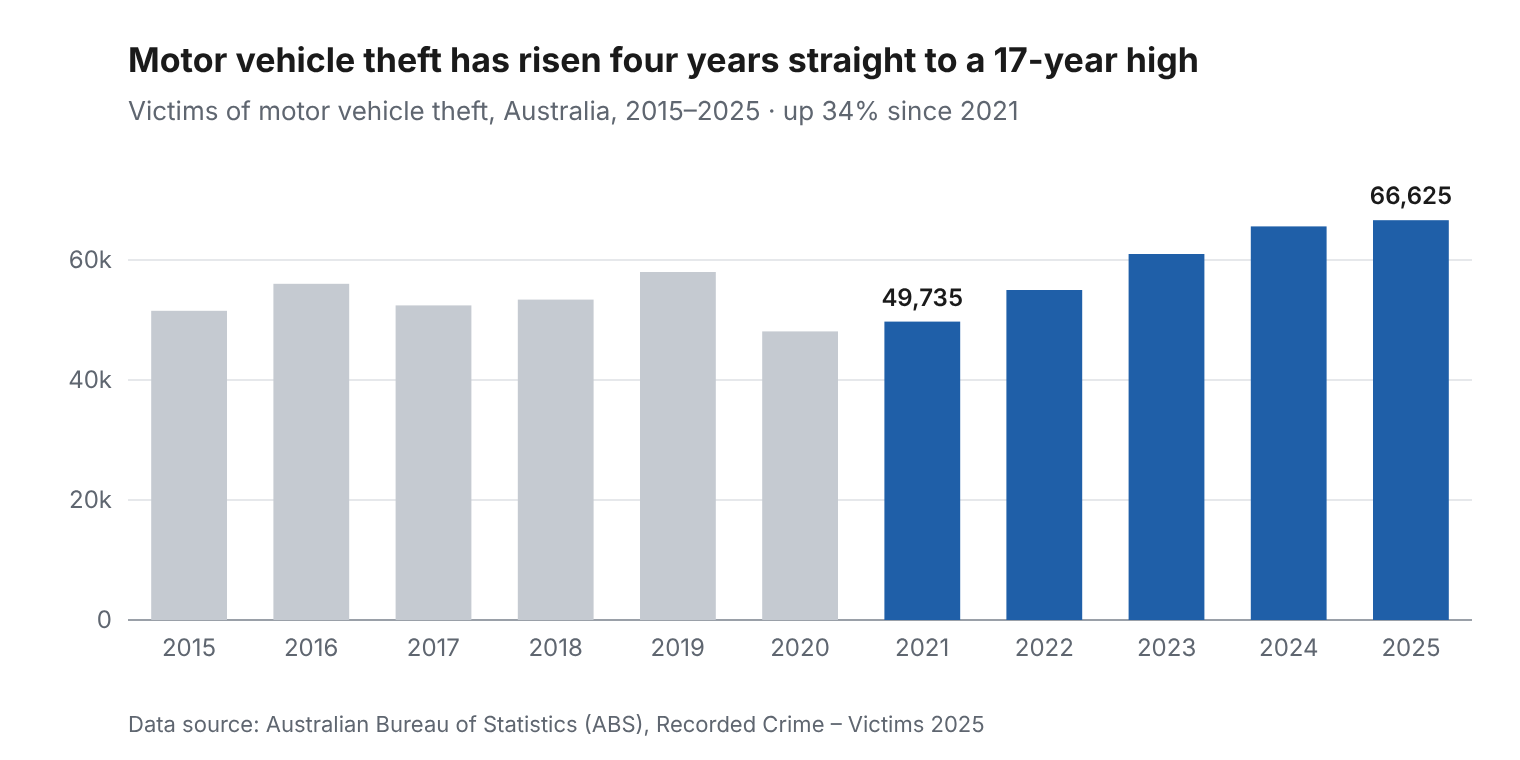
Motor vehicle theft has climbed every year since 2021, reaching 66,625 victims in 2025 according to the ABS. Many vehicles are taken close to home: 54% of stolen vehicles in NSW and 53% in Queensland were taken from an outbuilding or residential land.
The ABS Crime Victimisation survey points the same way, with 68% of thefts from motor vehicles happening while the vehicle was at the owner's home. The same after-hours exposure applies to car parks, depots, dealerships and fleet yards, which often sit unattended overnight.
Break-ins: fewer, but still common
In 2024–25, 1.8% of Australian households (196,600) experienced a break-in, down from 2.1% the year before, and a further 2.0% (217,500) experienced an attempted break-in. When a break-in did occur, 69% of households had something stolen, 44% had property damaged and 12% had the offender confront someone.
Recorded burglary also fell across the larger states in 2025, but a significant share happened away from homes:
| State, 2025 | Burglary victims | Change on 2024 | Share at non-residential locations |
|---|---|---|---|
| Victoria | 42,692 | Down 7% | 38% |
| Queensland | 40,088 | Down 12% | 36% |
| New South Wales | 30,706 | Down 7% | 28% |
| Western Australia | 13,312 | Down 20% (lowest on record) | 33% |
| South Australia | 8,789 | Down 11% | 26% |
Data source: ABS, Recorded Crime – Victims 2025. Non-residential share calculated from the ABS residential location share.
For commercial sites, the risk concentrates outside business hours when fewer people are around to notice. Verified Grade A1 alarm monitoring, intelligent CCTV that flags after-hours movement, and mobile patrols with alarm response close that gap.
Workplace violence: frontline, retail and healthcare workers
The fastest-growing security risk for many organisations is not to property but to people. Across retail, hospitality and healthcare, the data shows frontline staff facing more aggression, more often.
Work is a common setting for violence. In the ABS Crime Victimisation survey, 38% of the most recent face-to-face threatened assaults happened at work, for both men and women. More than a quarter of physical assaults also took place at work (27% of men's and 28% of women's most recent incidents).
Workers' compensation data tells the same story. Safe Work Australia found a 56% increase in serious claims for assault and exposure to workplace violence over five years, with clients and customers the most common source.
Retail and fast food workers
A survey of close to 3,000 retail, fast food and warehouse workers by the SDA found:
- 88% had experienced verbal abuse from a customer in the past 12 months
- 25% had experienced physical violence, double the 2023 figure and three times the 2021 figure.
Shoppers are seeing it too. In a separate SDA survey of shoppers, 71% said they had experienced or witnessed abuse directed at retail or fast food workers, and 13% had seen threats involving a weapon.
Hospitals and health services
Assault is now the second leading cause of injury hospitalisation among Australian health care workers, up from fourth a decade ago. The AIHW recorded 126 assault-related hospitalisations in 2024–25, a rate of 8.1 per 100,000 workers, compared with 49 (4.3 per 100,000) in 2015–16.
Hospitalisations capture only the most serious incidents. A NSW Nurses and Midwives' Association report found 88% of nurses and midwives experienced occupational violence in the past six months, up from 80% in 2019. The Australasian College for Emergency Medicine reported that nine in 10 emergency department directors had witnessed violent incidents in their department in the past week.
What this means for employers
Under work health and safety laws, employers have a duty to manage the risk of work-related violence, including violence from customers, patients and members of the public. Practical controls include a visible security presence, officers trained in Occupational Violence and Aggression (OVA) and de-escalation, and duress alarms backed by a monitored response.
For higher-risk environments such as emergency departments, nightlife precincts and late-trading venues, tactical guarding and dedicated health and pharmaceutical security provide an additional layer of protection.
Cybercrime and the case for integrated security
Cyber threats are no longer a separate problem from physical security. The ASD's Annual Cyber Threat Report 2024–25 found:
- more than 84,700 cybercrime reports were made, an average of one every six minutes
- ASD responded to more than 1,200 cyber security incidents, up 11% on the previous year
- the average self-reported cost of cybercrime per business report rose 50% to $80,850.
Costs rose for organisations of every size:
| Business size | Average cost per cybercrime report, 2024–25 | Change on 2023–24 |
|---|---|---|
| Small | $56,600 | Up 14% |
| Medium | $97,200 | Up 55% |
| Large | $202,700 | Up 219% |
Data source: ASD, Annual Cyber Threat Report 2024–25 fact sheet for businesses
Modern access control, CCTV and alarm systems are networked devices, so they form part of an organisation's attack surface. A lost access card, an unsecured camera or a stolen laptop can be the starting point for a data breach, just as a cyber compromise can disable physical protections.
That is why an integrated security approach, where guarding, technology and monitoring are designed and managed together, matters more each year. EXEC Security holds ISO 27001 certification for information security management alongside its physical security accreditations.
What the statistics mean for your security strategy
Taken together, the data points to a clear shift. Risk is concentrating in retail and public-facing settings, falling increasingly on staff rather than stock, and peaking outside business hours. The table below links each trend to the measures most likely to address it.
| Trend in the data | What it means on site | Measures to consider |
|---|---|---|
| Retail theft at record levels in NSW and Victoria | Repeat and organised offenders cause a disproportionate share of loss and harm | Covert and uniformed loss prevention officers, CCTV covering exits and high-value lines, consistent incident reporting |
| Rising abuse and violence toward frontline staff | Staff safety and WHS obligations, not just stock loss | Visible security guards, OVA-trained officers, duress devices with monitored response |
| Assaults on health care workers doubling in a decade | Emergency departments and wards need trained, consistent security support | Health and pharmaceutical security, tactical guarding |
| Motor vehicle theft at a 17-year high | Car parks, depots and fleet yards are exposed overnight | Access-controlled car parks, lighting, monitored CCTV with analytics, mobile patrols |
| Hundreds of thousands of break-ins and attempts each year | Unoccupied sites are most vulnerable after hours | Grade A1 alarm monitoring, alarm response patrols, intelligent CCTV |
| Rising cost of cybercrime | Networked security systems are part of the attack surface | Integrated electronic security, regular access audits |
| Significant under-reporting | Police data understates the real risk to a site | A security risk assessment and regular audits based on your own incident data |
No single measure addresses every risk. The strongest results come from layers that work together: trained people on site, technology that detects early, a monitoring centre that verifies and escalates, and procedures that everyone understands. Our corporate security guide explains how to build that kind of program step by step.
Protecting your people and property with EXEC Security
Since 2006, EXEC Security has helped Australian organisations turn risk data into practical, tailored protection. As a fully integrated provider, we bring the full range of services under one partner:
- Security guards: static, tactical and covert loss prevention officers trained in de-escalation and incident response
- Mobile patrols: scheduled and random site checks and rapid alarm response
- Grade A1 remote monitoring: our Security Operations Centre monitors more than 20,000 alarm, CCTV, duress, access control and medical monitoring systems nationally
- Electronic security: CCTV, access control and alarm design, installation and upgrades, plus Camera-as-Alarm intelligent CCTV monitoring
- Concierge security: a professional, welcoming front-of-house presence for corporate and residential buildings
- Risk Advisory: security risk assessments, audits and bespoke security plans.
Serving businesses across Melbourne, Sydney, Brisbane, Adelaide and Perth, we design each solution around the risks your site actually faces, not a generic template.
Get a free security quote
Worried about how these trends affect your business? EXEC Security offers a free, no-obligation consultation and quote, including insights and advice on the right security strategy for your site.
Frequently asked questions
Is crime going up or down in Australia in 2026?
It depends on the offence. Nationally, theft fell 2% and robbery fell 8% in 2025, but motor vehicle theft rose to its highest level in 17 years. In NSW, most crime was stable over the two years to June 2026, with retail theft the only major category rising. In Victoria, total offences fell 2.1% in the year to June 2026 but remain 13.2% higher than three years earlier.
Where does most theft happen in Australia?
Retail locations. In 2025, 43% of thefts recorded nationally (247,425 victims) took place at a retail location, according to the ABS. In Queensland and South Australia the share was more than half.
How common is retail theft in Australia?
Very common, and rising in the largest states. NSW recorded 32,835 retail theft incidents in the 12 months to June 2026, almost 90 a day. Victoria recorded 43,124 theft from retail store offences in the same period, up 2.7%.
How much does retail crime cost Australian businesses?
Retail industry peak bodies, now combined as the Australian Retail Council, estimate retail crime costs the sector more than $9 billion a year. Much of that cost ultimately flows through to higher prices for customers.
Is workplace violence increasing in Australia?
The available data says yes. Safe Work Australia found a 56% increase in serious workers' compensation claims for assault and exposure to workplace violence over five years. One in four retail and fast food workers surveyed by the SDA reported physical violence, and assault-related hospitalisations of health care workers more than doubled in a decade.
Why might crime statistics underestimate the risk to my business?
Police figures only include incidents that are reported. The ABS found that only 69% of household break-ins and 40% of face-to-face threatened assaults were reported to police in 2024–25. A site-specific risk assessment based on your own incident records gives a more accurate picture.
What is the most effective way to reduce security risk?
A layered approach. Combining trained security officers, electronic security such as CCTV and access control, 24/7 monitoring and clear incident procedures gives better coverage than any single measure. A security risk assessment is the best starting point for deciding which layers your site needs.
Related Posts

Last updated on October 2, 2026

Enquire Now
Speak with a
Security Guarding Specialist
Whether you require a welcoming concierge, vigilant static guard, loss prevention team, or comprehensive site coverage, EXEC Security has the experience, systems, and personnel to deliver. Contact us today to arrange a consultation or request a tailored service proposal.


