

Last updated on August 5, 2026
Corporate Security Guide for Australian Businesses
Corporate security is becoming increasingly critical as Australian organisations navigate a more complex and fast-moving risk environment. Unauthorised access, internal theft, workplace violence, operational disruption and cyber-enabled threats can all place people, property and business continuity at risk.
For facilities managers, office managers and security leaders, effective corporate security is not simply about responding to incidents. It requires a coordinated approach that strengthens resilience, supports compliance and ensures the organisation is prepared to identify, manage and respond to emerging threats.
This guide explains what corporate security involves, the services that support it and what organisations should expect when partnering with a security company in Australia.
Corporate Security Guide for Australian Businesses – Jump to Content:
- What Is Corporate Security?
- Who Needs Corporate Security?
- Common Risks In Corporate & Commercial Properties
- Managing Corporate Security Risks With An Integrated Security Company
- What Is Integrated Security?
- 5 Key Security Measures For Corporate & Commercial Properties
- Security Audits For Corporate & Commercial Properties
- How To Implement a Corporate Security Strategy
- Engaging With EXEC As Your Corporate Security Partner
- Get A Free Corporate Security Quote
What is Corporate Security?
Corporate security is about more than protecting assets; it’s about enabling safe, uninterrupted business operations.
Corporate security combines:
- Physical security (guards, patrols, access management)
- Technology (CCTV, alarms, access security)
- Processes (incident response, compliance, reporting)
When aligned properly, these elements don’t just reduce risk; they improve efficiency, culture, and employee confidence.
Who Needs Corporate Security?
Corporate security is essential for organisations that need to protect their people, premises, information and reputation, from office-based businesses and commercial property groups to finance, legal, retail, industrial and large enterprise environments.
Office-based businesses that need front-of-house security, access control, visitor management, staff safety and after-hours protection.
Commercial property owners and managers responsible for multi-tenant buildings, shared facilities, car parks, loading docks and common areas.
Finance, legal and professional services firms that handle sensitive information, high-value transactions, confidential client matters or reputational risk.
ASX-listed and large enterprises that require consistent security standards across offices, sites, executives, assets and operations.
Industrial, logistics and warehouse environments that need perimeter protection, gatehouse control, patrols, contractor management and loss prevention.
Retail and mixed-use sites managing theft, antisocial behaviour, customer safety, staff safety and public-facing risk.
Organisations with lone workers, high-profile staff or vulnerable visitors where safety, discretion and escalation processes are critical.
Current Corporate Security Risks
Security risks are increasingly common and can carry serious consequences, from financial loss and operational disruption to long-term reputational damage.
Managing these risks effectively is essential to protecting people, assets, reputation and the longevity of your brand.
Common Risks in Corporate & Commercial Properties
| Risk | Potential Impact |
|---|---|
| Unauthorised access | Data breaches, safety risks |
| Internal or external theft | Financial loss |
| Workplace violence | Staff safety and liability |
| Business disruption from external threats | Downtime, revenue loss |
| Break-ins & vandalism | Asset damage, insurance costs |
Managing Corporate Security Risks with an Integrated Security Company
Security and safety risks in corporate and commercial environments are broad, complex, and require a team of people to properly manage them, often requiring engaging with a security company.
The most effective and efficient way is to engage with a full-service security provider who can offer the full range of security services required to manage your business’s security holistically.
Why choose one provider?
A single provider covering guarding, technology and monitoring means one point of accountability, consistent reporting, and a security program that is designed to work as one system rather than a collection of disconnected services.
What Is Integrated Security?
Integrated security combines traditional physical guarding (security personnel) with electronic security systems (like CCTV, alarms, and access control) into a single, cohesive network. This unified approach allows on-site or remote guards to immediately leverage technology for faster threat detection, real-time monitoring, and more efficient incident response.
5 Key Security Measures for Corporate & Commercial Properties
Effective corporate security is rarely the result of a single measure. In most cases, it comes from several layers of protection working together: technology, trained personnel, and tested procedures that operate in coordination.
The five measures below cover the core components of a well-structured security program for commercial and corporate environments.
- Access Control
- Physical Security Presence
- Monitoring & On-Site Surveillance
- After-Hours Security
- Incident Response
Understanding each one individually, and how they support each other, gives you a clearer picture of what comprehensive site protection looks like in practice.
1. Access Control for Corporate Security
Access control determines who can enter a site, which areas they can access, and when.
Electronic Access Controls
This includes key card and fob systems, biometric readers, PIN-based entry, and automated door hardware, all of which can be managed and logged through a central platform.
Physical Access Control
A concierge or front-of-house security officer performs the same function in person: verifying identities, issuing visitor passes, managing contractor access, and monitoring who is entering and leaving the building.
Electronic systems create an auditable record of access events; trained personnel apply judgment in situations the technology cannot, such as escorting an unregistered visitor or recognising behaviour that doesn’t match a presented credential. Together, they form the first line of defence against unauthorised entry.
2. Physical Security for Corporate & Commercial Properties
A visible security presence changes how a site is perceived and, by extension, how it is approached.
Static & Tactical Guards
Deployed at fixed positions, typically entry points, reception areas, or high-value asset locations, where consistency and visibility are the priority. Tactical guards can be deployed for higher-risk, dynamic environments such as large public venues, high-security banking facilities, hospitals, and busy commercial or nightlife precincts. They’re trained in advanced threat neutralisation, Occupational Violence and Aggression (OVA) preparedness, and managing high-intensity scenarios.
Covert or Plain-Clothed Security Officers
Helps retail businesses prevent profit loss (shrinkage) by catching professional and opportunistic shoplifters in the act without disrupting the everyday shopping experience.
Managing Workplace Violence with a Security Presence
Violence in corporate and commercial settings is a genuine risk for Australian businesses. According to the Australian Bureau of Statistics (ABS), over 1 million incidents of work-related violence have been reported in Australia, and there has been a 56% increase in the number of serious workers’ compensation claims for assault and exposure to workplace violence over the past 5 years.
3. Monitoring & Surveillance for Corporate & Commercial Buildings
Monitoring extends security coverage beyond what any single person or team can observe directly.
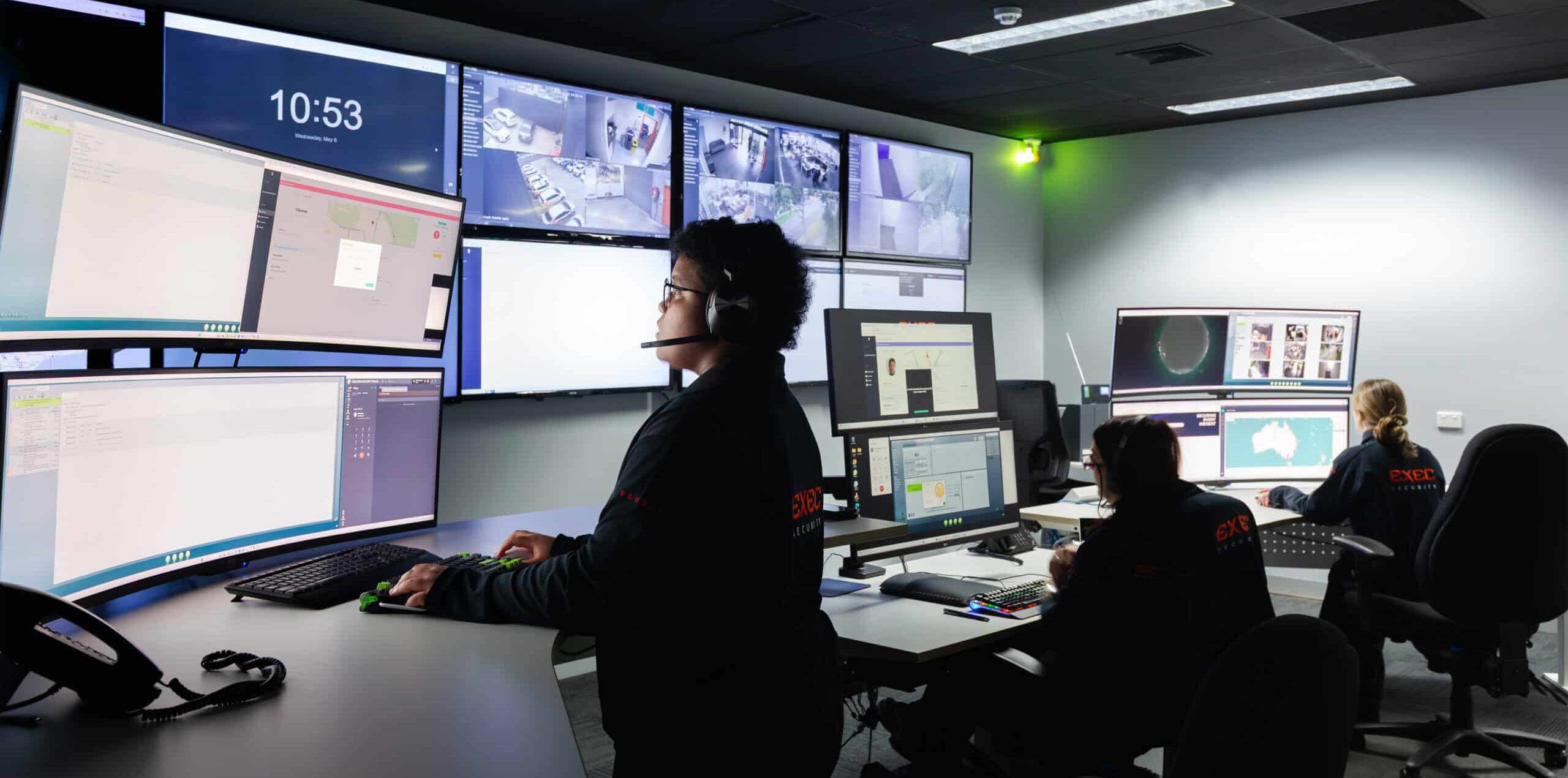
Grade A1 remote monitoring centres receive and process alarm signals and CCTV feeds around the clock, with the capacity to assess incidents, communicate with on-site teams, and coordinate responses in real time. When enhanced by AI-enabled monitoring capability, intelligent threat detection can be customised to identify and verify trespassers in real time, instantly alerting on-site security and monitoring centre staff to respond to the incident.
What is Grade A1 Remote Monitoring?
Grade A1 is the highest classification under Australian Standard AS 2201.2 for security monitoring centres, also known as Security Operations Centres (SOC), or control rooms. Grade A1 classification requires the monitoring centre to meet rigorous standards across secure site construction and access, redundant power and communications, staff training and certification, response timeframes and protocols, and technology. These areas are independently audited and maintained to ensure standards are genuinely met. For clients, it means their alarms are monitored by a centre that has been assessed to the highest benchmark. It’s often a mandatory requirement for government, financial, and critical infrastructure contracts.
Duress and panic monitoring ensures that staff in a distress situation can trigger an immediate response, whether through a fixed duress button, a wearable device, or a dedicated application.
On-site monitoring, where security personnel manage CCTV and alarm systems from within the building, is often deployed alongside remote monitoring for sites that require a higher level of direct oversight.
These tools and formats are most effective when they feed into a single, coordinated response framework rather than operating independently.
Proven Impact of Surveillance
Businesses using CCTV report up to a 50% reduction in theft and significantly faster incident resolution. CCTV monitoring can be a highly effective addition to a corporate security strategy, but organisations must also consider their legal obligations. Employee surveillance laws vary across Australia, with different requirements depending on the state or territory, the type of monitoring used and how employees are notified. Businesses should confirm the rules that apply in their location before implementing CCTV or remote monitoring.
A reputable security provider can help ensure monitoring is delivered in line with relevant workplace surveillance laws, privacy requirements, site policies and third-party compliance standards.
4. After-Hours Security for Corporate & Commercial Buildings
The period after business hours presents a distinct set of risks. With fewer people on site and less routine activity to mask unusual events, detection depends almost entirely on technology and patrol coverage.
Grade A1 remote monitoring provides continuous oversight throughout the night, with operators trained to identify and respond to alarm activations, CCTV alerts, and access anomalies.
Mobile patrol units provide a physical presence, conducting scheduled and random checks across one or multiple sites. Patrols serve both a deterrent function and a response function: their visibility discourages opportunistic activity, and their presence means that if something does occur, a trained officer can be on the ground quickly.
For many organisations, after-hours security is handled through a combination of both: remote monitoring provides constant visibility, while mobile patrols provide periodic physical verification and the ability to respond when something requires investigation.
5. Corporate Security Incident Response
When something happens, the speed and quality of the response matters. This depends on two things: having the right people available, and having documented procedures in place before an incident occurs.
Trained security staff operating under site-specific protocols know how to respond to different types of events, whether that is a triggered alarm, an access breach, an aggressive person on site, or an emergency requiring evacuation. Protocols are developed in advance based on the site’s layout, the nature of its operations, and the most likely risk scenarios, so that decision-making under pressure follows a tested process rather than an improvised one.
Alarm response units, often dispatched from a monitoring centre when an alert is triggered, provide a rapid physical response capability at sites where on-site staff may not be present around the clock. Their role is to attend, assess, and take immediate action, whether that means securing the site, liaising with police, or escalating to the appropriate contact.
An incident response plan is only as effective as the people and systems behind it. When monitoring, physical presence, and documented procedures are aligned, response times improve and outcomes are more consistent.
Security Audits for Corporate & Commercial Properties
A security audit is a structured review of your current security measures against the unique risks of your property and operations. It should be conducted periodically, not just at the start of a new contract, and when there are changes to your operations, tenancy, or risk environment.
A thorough audit examines your site’s vulnerabilities, reviews existing controls and produces clear recommendations for addressing any shortfalls.
Beyond risk reduction, regular audits support compliance obligations, strengthen your position with insurers, and provide documented due diligence should an incident occur.
How To Implement a Corporate Security Strategy
Follow these steps to build a security program that reflects your actual risk profile rather than a generic solution.
|
1
|
Assess your risk environment. Identify the assets, people, and operations that need protection. Consider site hardening, electronic, and information security risks, and the specific threats relevant to your industry and locations. A qualified security provider can conduct a formal site risk assessment to inform this process. |
|
2
|
Define your security objectives. Establish what the strategy needs to achieve, whether that is protecting people, safeguarding assets, meeting compliance obligations, or all three. Your security provider should contribute to this discussion, bringing sector experience and knowledge of emerging threats. |
|
3
|
Audit current security measures. Review what is already in place across guarding, access control, surveillance, monitoring, and policies. A security provider can help identify gaps between current capability and what your risk profile demands, and recommend where investment will have the most impact. |
|
4
|
Design the security framework. Work with your provider to develop an integrated approach covering personnel, technology, procedures, and governance. A good provider will tailor this to your operations rather than applying a generic solution, considering how static guarding, mobile patrols, electronic security, and monitoring work together as a single system. |
|
5
|
Implement and communicate. Your security provider should manage a structured mobilisation, deploying personnel, commissioning technology, and establishing escalation and communication protocols. Internally, ensure staff understand relevant policies and know how to engage security when needed. |
|
6
|
Establish reporting and oversight. Your security partner will deliver regular reporting on incidents, patrol activity, alarm responses, and system performance. This gives you visibility over the strategy in operation and supports ongoing governance. |
|
7
|
Test and audit. Work with your security provider to conduct regular testing of systems and procedures. |
|
8
|
Review and optimise. Your security provider should proactively flag changes in the threat environment and recommend strategy adjustments as your operations evolve. |
Corporate Security with EXEC
At EXEC Security, we deliver end-to-end, fully integrated corporate security solutions across Australia.
We bring together a full suite of services under a single provider:
- Grade A1 SOC remote monitoring
- Static and mobile guarding
- Electronic security
- Concierge services
These services are underpinned by a collaborative and experienced account management team, highly trained security personnel, and advanced security technologies.
Providing you with a reliable security partner, transparent reporting, and confidence that your people, assets, and operations are protected.
Get A Free Corporate Security Quote
Looking for corporate security in Australia? EXEC Security offers a free, no-obligation quote, including insights and advice on the best strategy for your business.
Related Posts

Last updated on September 1, 2026


Enquire Now
Speak with a
Security Guarding Specialist
Whether you require a welcoming concierge, vigilant static guard, loss prevention team, or comprehensive site coverage, EXEC Security has the experience, systems, and personnel to deliver. Contact us today to arrange a consultation or request a tailored service proposal.

