

Last updated on October 2, 2026
Hospitality Security Fund Victoria: a security guide for Melbourne licensed venues
Melbourne’s hospitality sector has faced a serious escalation in targeted violence throughout 2026. Since April, licensed venues, including restaurants, pubs, bars and nightclubs, have been hit by firebombings, arson attacks, attempted arson and shootings, with some operators also reporting gang threats and threatening messages.
Victoria Police established Operation Eclipse to investigate the attacks and identify those responsible. The motive was initially unclear, and police urged venue operators and the public to stay alert to suspicious behaviour. More recent police allegations have linked some incidents to organised crime activity. As this remains an active police matter, venue operators should rely on official advice rather than speculation.
In response, the Victorian Government has launched the $10 million Hospitality Security Fund Victoria, a licensed venue security grant offering eligible hospitality businesses rebates of between $5,000 and $25,000 to install or upgrade security and fire safety systems.
Applications close at 4 pm on Friday 28 August 2026, or earlier if all available funding is allocated. Because funding may be awarded on a first come, first served basis, eligible venues should apply as soon as possible.
Jump to Content:
- Firebombing and gang threats: why Melbourne venues need to review security
- What is the Hospitality Security Fund Victoria?
- Hospitality Security Fund eligibility: does your venue qualify?
- What does the Hospitality Security Fund cover?
- Costs the grant does not cover
- How to apply for the Hospitality Security Fund
- CCTV and electronic security for Melbourne pubs, bars and licensed venues
- Camera-as-Alarm: EXEC’s intelligent CCTV monitoring service
- Police, emergency services, and mobile patrols coordination
- Melbourne hospitality and licensed venue security from EXEC
- Frequently asked questions
Firebombing and gang threats: why Melbourne venues need to review security
While most attacks have occurred after hours, risk to hospitality venues doesn’t end when the doors close. A practical security plan needs to cover all operating conditions:
- During trading hours: protecting staff and patrons, managing threatening behaviour, monitoring entrances and restricted areas, and coordinating an emergency response.
- After hours: detecting people or vehicles approaching the site, identifying unauthorised entry, preserving usable footage and arranging a timely response before an incident escalates.
In April, ABC News reported seven arson attacks on licensed venues in a single week, while police asked the public to report suspicious behaviour. By late April, 15 incidents had been brought under Operation Eclipse. In May, venue operators reported threatening messages alongside the attacks.
Security technology can’t remove every risk or replace police. It can, however, improve early detection, give staff a clearer way to raise the alarm, support faster verification and response, and preserve evidence after an incident.
What is the Hospitality Security Fund Victoria?
The Hospitality Security Fund is a Victorian Government grant for eligible licensed hospitality venues in four inner-Melbourne council areas. It supports the installation or upgrade of fixed security and fire safety systems and equipment.
The program offers two grant options.
1. Security Uplift Grant
- A $5,000 rebate for an eligible venue to improve its security or fire prevention systems.
- The venue does not need to have been directly affected by fire-related crime.
- The business must contribute at least another $5,000.
- This means the applicant must spend at least $10,000 upfront on eligible expenditure to receive the $5,000 rebate.
For this grant, project materials and equipment must be purchased and paid for in full between the date the grant is approved and 28 February 2027. Do not commit to project expenditure before approval if you intend to claim it under this grant.
2. Direct Impact Grant
- A rebate of $5,000 to $25,000 for an eligible venue directly affected by fire-related criminal damage investigated by Operation Eclipse since 1 March 2026.
- No matched contribution is required.
- The application must include a Victoria Police Report, called a Notice to the Victim, and a statutory declaration.
IMPORTANT:
For this grant, eligible project materials and equipment must be purchased and paid for in full between 1 March 2026 and 28 February 2027. Both grants operate as rebates. The applicant pays the project costs upfront, with payment made only after the approved project has been completed, assessed and acquitted.
Hospitality Security Fund eligibility: does your venue qualify?
To qualify for either grant, a venue must meet all of the following conditions:
- Employ fewer than 50 people (by headcount) and be registered with WorkSafe Victoria
- Have held an active ABN, GST registration, and an eligible liquor licence continuously since 27 April 2026
- Be registered and operating continuously since 27 April 2026 under one of these ANZSIC classes: 4511 (Cafes and Restaurants), 4520 (Pubs, Taverns and Bars), or 4530 (Clubs, Hospitality)
- Be open to the public past 6pm at least once a week
- Not be insolvent, with no owners or directors who are undischarged bankrupts
- The venue must be located in the City of Melbourne, Port Phillip, Stonnington, or Yarra.
Only one grant can be received per eligible venue. If one ABN covers several venues, a separate application is required for each venue.
IMPORTANT:
For the full and current eligibility criteria, see the Hospitality Security Fund page on Business Victoria.
What does the Hospitality Security Fund cover?
The official guidelines list the following as eligible security and fire safety measures:
- a security or fire suppression audit by a qualified professional
- new or upgraded CCTV cameras, unless CCTV is already required as a condition of the venue’s liquor licence
- alarm systems, motion detectors and glass-break detectors
- lockable cash drawers, tills and safes
- emergency lighting and illuminated exit signage beyond the required minimum
- fire suppression or control equipment, including sprinkler upgrades
- building works that restrict access or make forced entry more difficult, provided they do not impede fire safety
- emergency security, evacuation and response training.
Each proposed item should clearly connect to a security or fire risk at the venue. A site assessment can help identify blind spots, vulnerable access points, poorly lit approaches, restricted areas and the coverage needed to obtain useful footage.
What the grant does not cover
Not every security expense is covered. Important exclusions include:
- ongoing monitoring by a security company
- security guards or patrol response services
- salaries, wages and other business operating expenses
- running and maintenance costs for security or fire equipment
- equipment hire
- body-worn or wearable cameras and devices
- CCTV that is already required by the venue’s liquor licence
- equipment that does not comply with Australian Standards
- work completed by providers without the required qualifications or licences
- costs covered or claimable through insurance
- work without the necessary permits or approvals
- upgrades that only bring a venue up to an existing legal, licence or regulatory minimum.
This means fixed CCTV, alarm equipment and eligible installation work can form part of a grant-funded project, while ongoing services such as EXEC’s Camera-as-Alarm monitoring and alarm response patrols need to be budgeted separately, unless Business Victoria confirms otherwise in writing.
How to apply for the Hospitality Security Fund
|
1
|
Confirm your eligibility and select the right grant. Check the official criteria, venue location, licence type and trading hours. If applying for the Direct Impact Grant, confirm that the fire-related damage was investigated under Operation Eclipse and that you have the required police documentation. |
|
2
|
Review the official information. Read the Hospitality Security Fund program page, the linked program guidelines and the frequently asked questions in full. |
|
3
|
Define the project and obtain cost evidence. Document the venue’s current security risks and the improvements you propose. Take photographs of the existing condition and obtain evidence of estimated costs, such as a written quotation, and confirm your provider holds all relevant licences and qualifications. |
|
4
|
Prepare the required documents. Applicants must provide:
Direct Impact Grant applicants must also provide:
|
|
5
|
Submit the online application. Use the application link on the official fund page. A saved draft is not a submitted application, so check for the confirmation email after submitting. |
|
6
|
Complete and claim the approved project. Approved expenditure must be paid in full by 28 February 2027. Once the work is complete, submit the claim form with paid invoices and photographic evidence. Keep all eligibility and expenditure records, as applications and projects may be audited for up to four years from the program opening date. |
GET HELP:
For application support, contact Business Victoria on 13 22 15 or info@business.vic.gov.au
CCTV and electronic security for Melbourne pubs, bars and licensed venues
CCTV delivers the most value when it’s designed around a venue’s actual risks, not simply added camera by camera.
Victoria Police advises that CCTV can help identify offenders, support remote property monitoring and act as a visible deterrent. Businesses can also voluntarily register privately owned CCTV with Victoria Police, allowing police to make contact if the system may have captured evidence relevant to an investigation.
So how can venues get more value from their CCTV investment?
By transforming it from a passive recording system into an active threat-detection solution.
Camera-as-Alarm: EXEC’s intelligent CCTV monitoring service
Traditional CCTV is often reactive. Footage is typically only reviewed after an alarm activates or once an incident has already occurred, and activity such as loitering, threatening behaviour or unauthorised entry may not trigger a conventional alarm at all.
EXEC’s Camera-as-Alarm service changes this. It turns your existing CCTV system into an active threat-detection solution, continuously analysing live footage against rules tailored to your venue’s layout, opening hours and risk profile. Depending on the cameras, software and agreed rules, this can include:
- Virtual perimeters: an alert when a person or vehicle crosses into a defined restricted area, such as a rear loading zone, rooftop access point or closed courtyard.
- Time-based rules: activity that is normal during trading hours can trigger an alert once the venue has closed.
- Loitering detection: flagging a person or vehicle that lingers near an entrance, service lane or boundary beyond a set period.
- Threat detection: identifying possible weapons, aggressive behaviour or unauthorised entry so an EXEC operator can assess and act.
- False alarm filtering: distinguishing genuine activity from common triggers such as wildlife, weather and passing traffic, so the Security Operations Centre is only notified when it matters.
- Fire detection: identifying smoke or flame within camera view so an EXEC operator can verify the event and coordinate with fire services for an immediate response.
Analytics support human decision-making rather than replace it. Camera placement, lighting, image quality and configuration all affect performance, so a trained EXEC operator reviews the footage and follows an agreed response procedure before any action is taken.
During trading hours
Camera-as-Alarm adds another layer of awareness while your managers and staff are focused on customers. It can flag activity near restricted areas, staff-only zones or rear laneways, helping your venue start its response sooner.
After hours
Once a venue closes, detection rules can become more sensitive. A person entering a rear yard, a vehicle stopping in a restricted loading area or movement near an entrance generates an alert for review, giving our monitoring team verified footage to decide whether to notify a venue contact, dispatch a patrol or escalate to emergency services.
Police, emergency services, and mobile patrols coordination
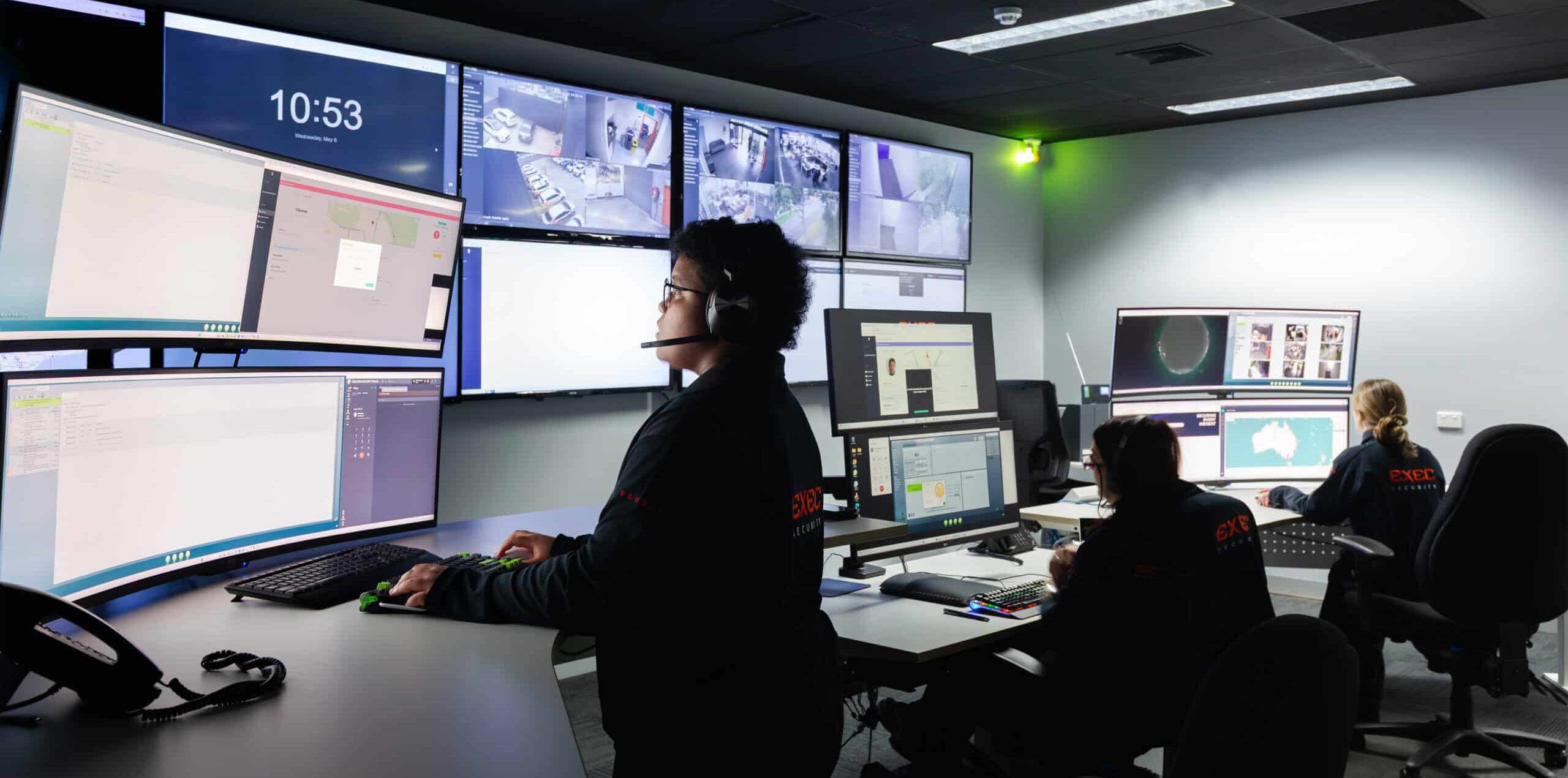
Detection is only part of the response. EXEC’s monitoring team coordinates directly with police, emergency services, and mobile patrols to turn a verified alarm or CCTV event into a fast, appropriate action on the ground.
Alpha Code protocol
For the highest priority alarms (Category A, such as an active break-in or duress activation), EXEC operators contact Triple Zero and authenticate the call using an assigned Alpha Code. This unique verification code confirms the operator’s identity and authorisation instantly, allowing police to dispatch without secondary verification delays.
An after-hours event, for example, could follow this process:
- The alarm or video programming detects activity.
- An EXEC monitoring operator reviews the footage to verify the incident.
- For emergency incidents, the operator contacts police using the Alpha Code protocol for immediate, verified dispatch.
- Where required, a nearby patrol officer attends, conducts an external or authorised site inspection, and reports the outcome.
- Emergency services are contacted where the circumstances require it.
A patrol service does not replace Triple Zero and should never delay an emergency call. If a crime is in progress, anyone is in danger, violence or weapons are involved, or urgent police attendance is required, call Triple Zero (000).
Victoria Police also provides specific business and venue arson-prevention guidance, including preserving CCTV footage and avoiding disturbance of potential evidence.
Melbourne hospitality and licensed venue security from EXEC
EXEC Security helps licensed venues build a practical, layered security response based on their site, trading hours and specific risks.
Our team can provide:
- a free site consultation to identify vulnerable areas and security priorities
- CCTV and electronic security design, installation and upgrades
- Camera-as-Alarm intelligent monitoring, with custom threat detection, virtual perimeters and time-based rules
- 24/7 monitoring through EXEC’s Grade A1 Security Operations Centre
- alarm verification, incident coordination and agreed escalation procedures
- mobile alarm response patrols
- a bespoke quotation that can support the cost-evidence requirements of a grant application.
Grant approval and eligibility are determined by Business Victoria. EXEC can scope and quote suitable security measures, but cannot guarantee that an application or individual project cost will be approved.
Applications close at 4 pm on Friday 28 August 2026, or earlier if funds are fully allocated.
Contact EXEC Security today for a free consultation and bespoke quote. We’ll assess your venue, identify practical improvements and develop a security solution that supports your people and premises during trading hours and after closing.
Frequently Asked Questions
Related Posts


Enquire Now
Speak with a
Security Guarding Specialist
Whether you require a welcoming concierge, vigilant static guard, loss prevention team, or comprehensive site coverage, EXEC Security has the experience, systems, and personnel to deliver. Contact us today to arrange a consultation or request a tailored service proposal.

